

How do you calculate a freelance day rate?
Divide the yearly revenue you need (target income, social contributions and business costs) by the number of days you will actually bill in the year. Then compare that figure with the rates charged in your field, and adjust it for your experience and specialism.
A day rate is the price of one working day billed to a client. It is often set by looking at what others charge. That is a useful benchmark, but it doesn’t tell you whether the price covers your costs and the days without work.
The method below starts from your own figures. It takes four steps and one division. It deals with the price of a day; to build a full set of offers (fixed prices, tiers, a pricing page), our guide Fixer ses prix (in French) covers the process.
What income do you need?
Start with the yearly net income you need, before income tax. Base it on your real personal spending, then add some savings: as a freelancer, the months without work are paid for by the busy ones.
What do your costs and contributions add up to?
Add what your business costs on top of that income:
- Social contributions, which depend on your status and your country.
- Business costs: equipment, software, insurance, accounting, training, travel.
Contribution rates vary from one status and country to another. Check the official figures for your case, or ask your accountant. In the example below, the rate is a calculation assumption, not a figure to reuse.
When contributions are a percentage of revenue, the formula is: target revenue = (target income + costs) ÷ (1 − contribution rate).
How many days can you really bill?
This is the step that needs the most honesty. A year has neither 365 billable days nor even all of its working days billable. Take away:
- weekends;
- your holidays;
- public holidays that fall on weekdays;
- non-billable time: prospecting, quotes, admin, accounting, training;
- gaps between projects and sick days.
What’s left depends on your field and on how steady your clients are. Estimate it honestly: an optimistic number gives a day rate that is too low.
How do you turn these figures into a day rate?
One division is enough: day rate = target revenue ÷ number of billable days.
The result is a floor. Below it, the business doesn’t cover the income you’re aiming for.
A worked example, step by step
Example: the figures below are calculation assumptions, chosen to illustrate the method. Replace them with your own. The method works the same in any currency.
| Step | Calculation and result |
|---|---|
| Target net income | €3,000 a month × 12 = €36,000 |
| Business costs | equipment, software, insurance, accounting: €4,000 |
| Social contributions | assumption: 25% of revenue |
| Target revenue | (36,000 + 4,000) ÷ (1 − 0.25) = €53,333 |
| Working days | 365 − 104 weekend days − 25 days of holiday − 9 public holidays on weekdays = 227 days |
| Non-billable days | prospecting, admin, training, gaps between projects: − 67 days |
| Billable days | 227 − 67 = 160 days |
| Floor day rate | 53,333 ÷ 160 = €333 a day, excluding VAT |
In this example, a day rate of €333 only just covers the target income. Rounding it to €350 leaves a margin for an unpaid invoice or a quieter month. With 120 billable days instead of 160, the same income would take €444 a day: the number of days weighs heavily in the result.
To check afterwards, project by project, whether your real day rate matches your target, a Notion template for freelancers that works out your real day rate from time spent saves you from redoing the sums by hand.
How do you compare your rate with the market?
The calculation gives a floor; the market gives a range. To find it, look at the rates published by freelancers in your field and at your level, ask peers, and note the budgets stated in the requests you receive.
If your floor is above the range, you have three levers: cut your costs, increase your billable days (more regular prospecting, longer projects), or aim for clients who value your specialism more. If it’s below, nothing forces you to align with the bottom of the range.
When and how should you raise your rate?
Apply a new rate to new clients first: the price is discussed at the first quote. For existing clients, announce the increase in advance, with a precise date, for example at the start of a new project or of the year.
Good reasons for an increase: a rarer specialism, work you can show, a tight deadline, a short project that takes as much prospecting as a long one.
Which mistakes should you avoid?
Starting from your old salary. Dividing a salary by the working days forgets the non-billable days and the costs an employer used to pay.
Forgetting gaps between projects. A year with no gaps at all is rare. Plan for them in the number of days, not in hope.
Lowering your rate to win a project. It is harder to raise it again with the same client. Reducing the scope keeps your rate intact.
Quoting a rate without stating VAT. If you charge VAT, it is added on top of the day rate. If you are not VAT-registered, say so on your quotes and invoices, using the wording your country requires.
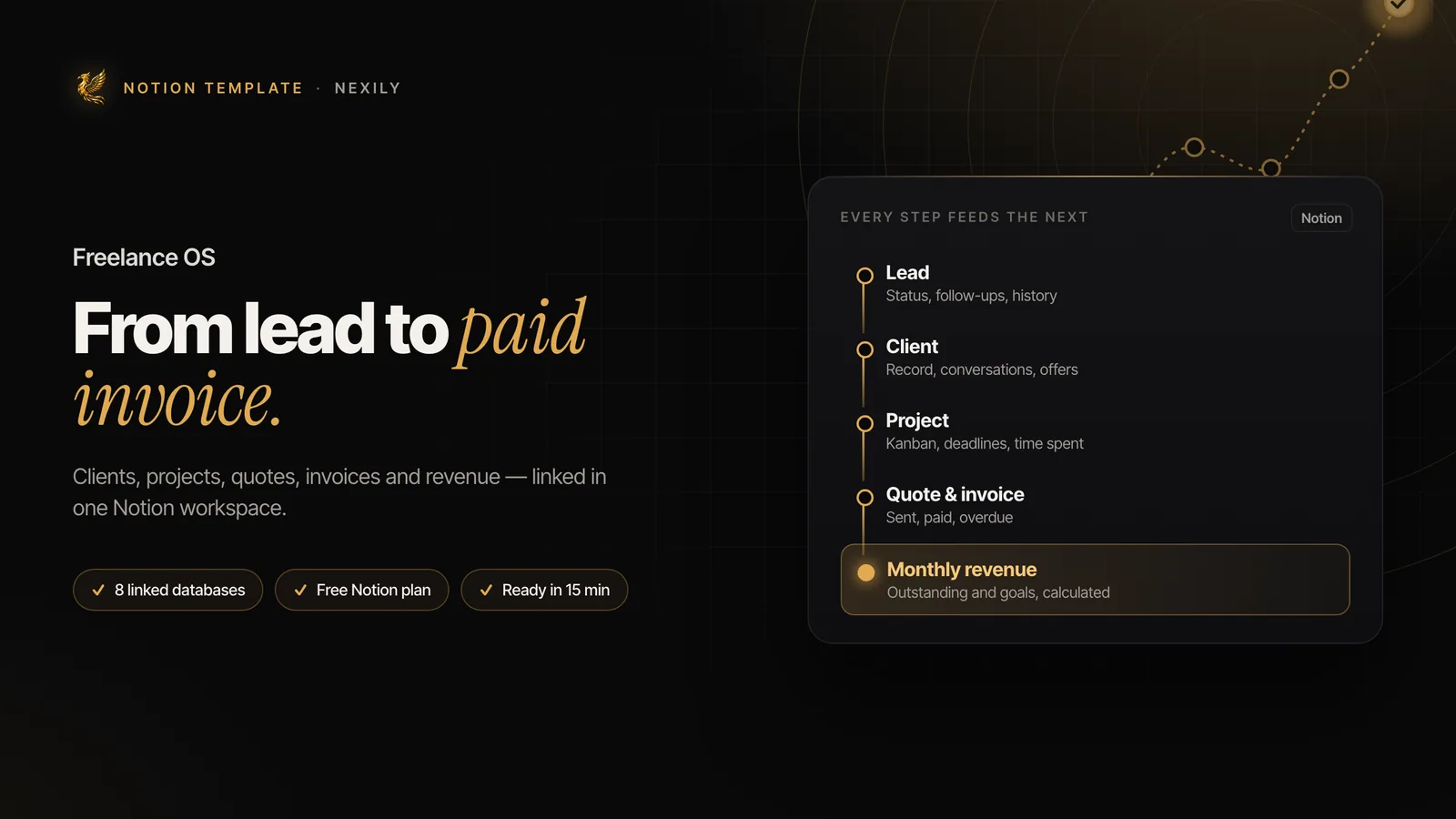
The Notion template to track clients, projects, quotes, invoices and time spent, with your real day rate for each project.
Discover Freelance OS